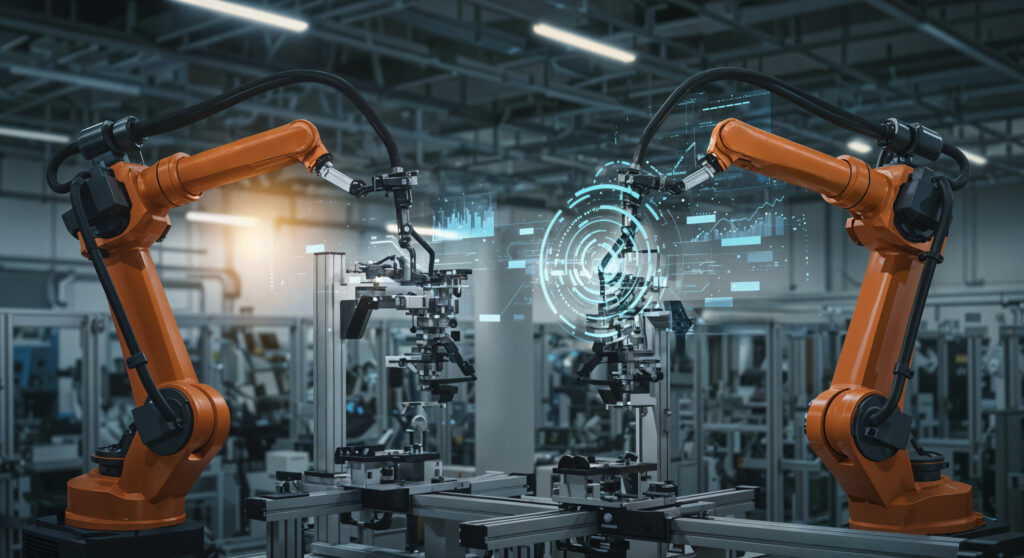
Artificial Intelligence has become the centerpiece of Industry 4.0 promises, from “lights-out factories” to “zero-defect production.” Yet in boardrooms around the world, COOs and CFOs are still asking the right skeptical questions:
Does AI actually reduce costs?
Is the ROI proven or just marketing hype?
Why do so many AI pilots fail?
Which use cases reliably produce real financial savings?
After reviewing research from McKinsey, Deloitte, Capgemini, MIT, the World Economic Forum Lighthouse factories, and over 200 real deployments, one truth is undeniable:
Yes, AI can significantly reduce manufacturing costs. But only when factories have the right data maturity, operational discipline, and governance.
This guide presents the most evidence-rich, challenge-proof analysis available today, built for executives who demand numbers, source-backed insight, and strategic clarity, not hype.
AI cost reduction in manufacturing refers to the application of predictive maintenance, AI-powered quality inspection, and machine learning forecasting to lower downtime, minimize scrap, optimize inventory, and automate high-cost manual processes. Verified savings range from 10% to 50%, depending on the factory’s digital maturity and asset readiness.
Predictive Maintenance: The Most Proven and Highest ROI AI Use Case
Why It Matters
Unplanned downtime costs:
$20,000–$260,000 per hour for discrete manufacturers (Siemens, ABB data)
$1–$2 million per hour for process industries like oil, chemicals, and semiconductors (Deloitte Smart Factory)
Downtime is the silent killer, and AI predictive maintenance (PdM) is the only system capable of detecting failures before they occur.
How AI Predictive Maintenance Works
AI models analyze:
Vibration frequency patterns
Acoustic signatures
Thermal anomalies
Motor current deviations
Pressure and flow irregularities
Cycle-time drift
These signals create an evolving baseline of “normal machine behavior.” Machine learning detects subtle deviations days or weeks before failure.
Real-World ROI Data
According to McKinsey, WEF Lighthouse Factories, and Capgemini:
Factory Type
Downtime Reduction
Maintenance Cost Reduction
Digitally Mature
40–50%
15–25%
Mid-Maturity
20–30%
8–15%
Low Maturity / Legacy Equipment
10–15%
5–10%
Where Predictive Maintenance Fails
AI predictive maintenance reduces unplanned downtime by 20–50% and maintenance costs by 10–25% in factories with strong sensor coverage and unified equipment data. AI predictive maintenance underperforms when:
Historical failure data is sparse
Sensor coverage is inconsistent
Machines operate in highly variable environments
Maintenance teams override or ignore alerts
MLOps pipelines are not built for continuous retraining
IT/OT integration is weak or incompatible
No CMMS integration exists
This is why most AI predictive maintenance pilots fail, not because the models are wrong, but because the data foundation is weak.
AI-Powered Quality Control: The Key to Eliminating Scrap & Rework
Why This Matters
Scrap, rework, and warranty claims destroy profit margins. In some industries, quality variation accounts for:
The Tough Reality: AI QC Only Works If the Environment Is Controlled
Performance collapses when:
Lighting fluctuates
Oil or dust contaminates lenses
Parts move unpredictably on the conveyor
Vibrations cause motion blur
Reflective metals create glare
This is why WEF Lighthouse factories invest heavily in:
Uniform lighting systems
Stable camera mounts
Enclosed inspection stations
Regular model retraining cycles
AI QC ROI (Backed by Deloitte, WEF, and Toyota Case Studies)
Environment Type
Defect Detection Accuracy
Scrap/Rework Reduction
Controlled
85–95%+
20–30%
Partially Controlled
70–85%
10–20%
Highly Variable
50–70%
5–10%
Hidden Financial Benefits Executives Usually Miss
AI QC also reduces:
Raw material waste
Machine energy consumption
Labor hours spent on visual inspection
Warranty claims and recalls
Lost customer lifetime value
The full ROI is often 2–5× larger than scrap reduction alone.
AI QC improves defect detection by up to 95% and reduces scrap by up to 30% when lighting, vibration, and environmental conditions are tightly controlled.
AI Supply Chain Optimization: Lower Inventory With Higher Service Levels
Most factories overspend on:
Excess inventory
Emergency orders
Overtime labor
Expedited freight
Safety stock inflation
AI forecasting changes this by analyzing:
Lead-time variability
Multi-year demand patterns
Seasonality trends
Macroeconomic signals
Customer behavior patterns
Production constraints
Supplier reliability
Real-World ROI (McKinsey + BCG + WEF)
Market Volatility
Inventory Reduction
Service Level Impact
Stable Demand
20–30%
95%+
Moderate Volatility
15–20%
92–95%
Highly Volatile
10–15%
90–93%
Even in volatile markets, AI outperforms traditional Excel/planner-driven forecasting by 30–50% in accuracy.
AI is a decision enhancer, not a replacement for planners.
AI supply chain optimization reduces inventory by 10–30% while improving service levels by forecasting demand more accurately than traditional planning.
Why AI in Manufacturing Fails: The 7 Red Flags Every Executive Must Manage
Most AI failures have nothing to do with the algorithm. They fail because of organizational readiness. The real failure causes:
Poor or inconsistent data
No sensor infrastructure
Legacy PLCs and SCADA systems
No MLOps or retraining pipeline
Lack of cross-functional ownership
Weak change-management discipline
Operators not trusting or using AI insights
Address these, and AI success becomes predictable and scalable.
Frequently Asked Questions
1. Does AI really reduce manufacturing costs?
Yes. Research from McKinsey, Capgemini, and WEF demonstrates repeatable 10–50% cost reductions depending on digital maturity.
2. What is the highest ROI AI use case?
Predictive Maintenance consistently delivers the fastest and largest financial return.
3. Is AI effective for older factories?
Yes, but the initial ROI is lower. Sensor upgrades, data cleaning, and PLC integration significantly increase results.
4. What is the typical ROI timeline?
6–18 months, depending on factory complexity and data maturity.
5. Can AI replace human operators?
No. AI augments operators by automating low-value detection and prediction tasks.
Conclusion: AI Is a Strategic Cost Engine, Not Just a Technology Upgrade
Across maintenance, quality, and supply chain operations, AI consistently delivers:
20–50% downtime reduction
10–25% maintenance cost reduction
85–95% QC accuracy
20–30% inventory reduction
Higher service levels and throughput
For manufacturing leaders, AI is not optional; it is the new competitive baseline.
If you are ready to accelerate your transformation: Contact Us Today Our AI manufacturing experts will help you:
Identify the most profitable AI use case
Quantify potential cost savings with real data
Design a pilot that delivers results in 6–18 months
Build a scalable roadmap for predictive maintenance, quality control, and supply chain optimization